Size is the decision people get wrong most often when they buy a throw blanket, and it is the hardest one to fix after the fact. A throw that looks generous in a product photo can turn out to be a lap warmer in person, while an oversized one meant for the couch swallows a reading chair. If you are buying for yourself, choosing a gift, or ordering a run of custom blankets for a team or event, a few standard numbers make the whole thing straightforward.
What actually counts as a standard throw
The default throw blanket measures 50 by 60 inches. That is the size most retailers mean when they list a product simply as a “throw,” and it is the size the majority of promotional and custom blankets are printed at. Fifty by sixty is big enough to wrap one adult on a sofa or drape across the foot of a bed, and small enough to stay light and easy to fold. When a listing gives no dimensions at all, this is a safe assumption, but it is always worth confirming, because the word “throw” describes a role in the room more than a fixed measurement.
From there the category spreads in both directions. A small or travel throw runs closer to 50 by 40 inches, sized for a stroller, a stadium seat, or a desk-chair nap. Step up and you find large throws around 70 by 60 inches and oversized versions near 80 by 70 inches, which give two people something to share without a tug-of-war. Those four sizes cover almost everything sold as a throw, and the gaps between them matter more than the labels, which is where the coverage comparison below helps.
How a throw compares to bed blanket sizes
A throw is not a shrunken bedspread. It is deliberately smaller than any bed blanket, because its job is to accent a sofa or add a layer, not to tuck in around a mattress. A twin blanket runs about 66 by 90 inches, a full around 80 by 90, a queen roughly 90 by 100, and a king about 108 by 100. Put a standard throw next to those and the difference is obvious: at 50 by 60 it is shorter and narrower than even a twin blanket. That is by design, and it is the reason a throw draped over a queen bed reads as a runner across the foot rather than full coverage.
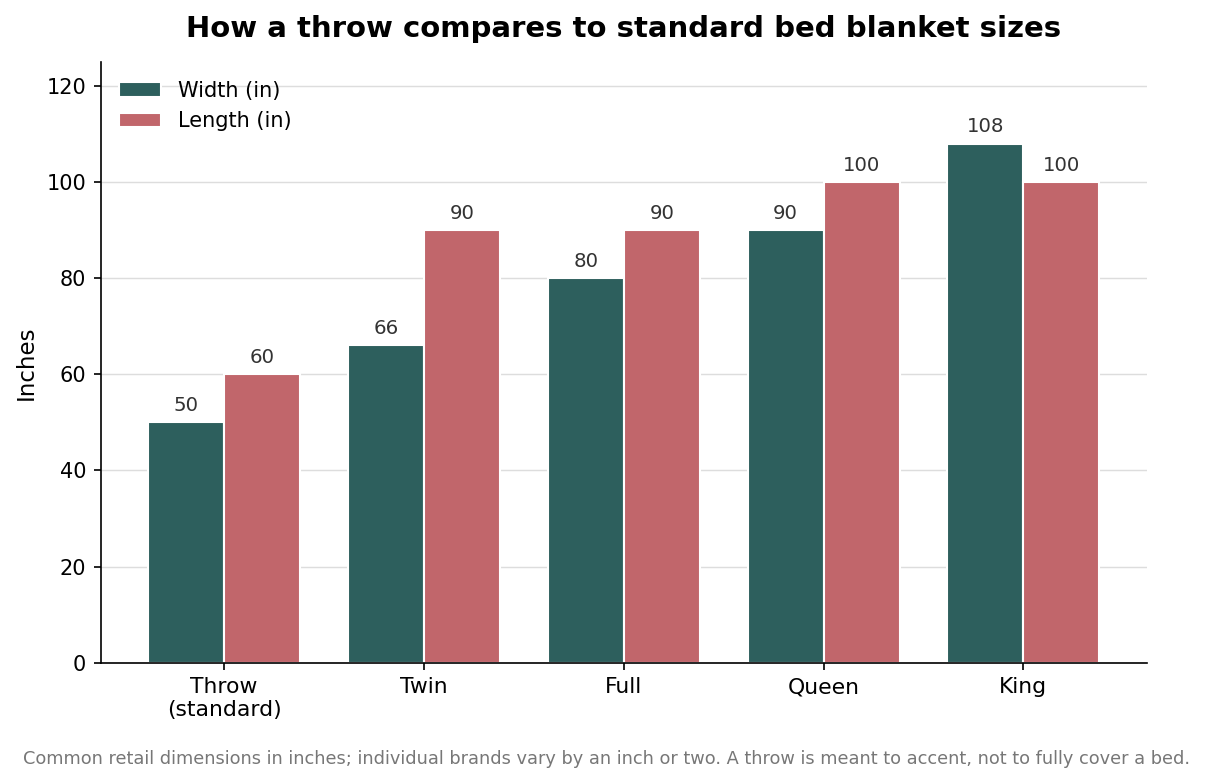
The practical takeaway is to stop thinking of a throw as bedding. If you want something that covers a sleeper on a bed, you are shopping for a bed blanket in the size that matches the mattress. If you want something to grab off the arm of the couch, live in on movie night, or hand out as a branded gift, a throw is the right category and 50 by 60 is your anchor point.
Matching the size to how you will use it
Coverage grows faster than the numbers suggest. Because area is width times length, each jump up the size ladder adds more square footage than the inch counts imply. A standard 50-by-60 throw covers about 21 square feet; a large 70-by-60 covers roughly 29; an oversized 80-by-70 reaches nearly 39. That is close to double the coverage from the smallest travel size to the oversized one, which is why a “slightly bigger” blanket can feel like a completely different product in use.
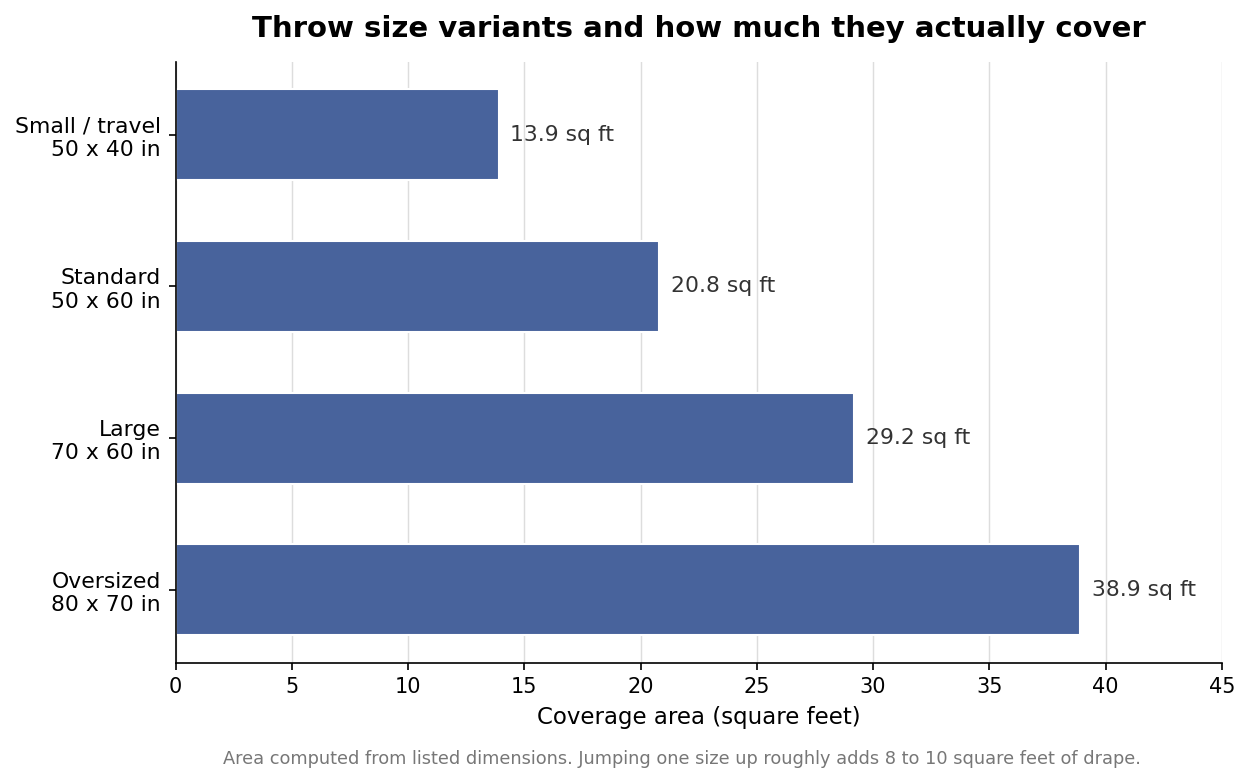
Let the use pick the size. For a single person on a couch or a kid’s room, the standard 50 by 60 is hard to beat and keeps cost and weight down. For a tall adult who wants their feet covered, or for two people sharing, move to a large or oversized throw so the blanket does not come up short. For travel, sports, and giveaways where portability and price matter more than full coverage, the small size earns its place. And for a decorative layer that simply drapes over furniture, the standard size photographs and folds best.
Sizing a custom or bulk order
Two production details affect the size you actually receive. The first is shrinkage: fabrics like fleece and woven cotton can pull in slightly after their first wash, often on the order of a few percent, so a blanket cut to exactly 50 by 60 may measure a touch smaller once it has been laundered. Reputable manufacturers cut with a small allowance to account for this, but it is worth asking how a supplier handles it if precise finished dimensions matter to you.
The second is weight, which travels with size. Fabric weight is measured in grams per square meter, and heavier goods feel warmer and more substantial but also cost more to make and ship. Lighter fleece throws sit in a lower GSM range, while plush sherpa styles commonly run from around 400 GSM for a midweight hand up to 600 GSM for a dense, cold-weather feel. Scale that across an oversized blanket and a bulk order, and the combination of a bigger cut and a heavier fabric can move both your unit cost and your freight noticeably, so it pays to settle size and weight together rather than one at a time.
For printed and custom work, also confirm the printable area and any bleed the supplier needs around the edges, since a design that runs to the very edge of a 50-by-60 blanket has to be built slightly larger so nothing important lands in the seam or the fringe.
The quick way to choose
Start from the standard 50 by 60 and adjust only if you have a reason to. Size up to a large or oversized throw when two people will share it or when a taller person wants full coverage; size down to the travel dimension when portability and price lead. Remember that a throw is intentionally smaller than any bed blanket, that coverage roughly doubles from the smallest size to the largest, and that on a custom order the finished size depends a little on the fabric and how the supplier cuts it. Settle those points before you order and the blanket that arrives will be the one you pictured.